





Sage 100 Partner ProgramSupportLogin
Thank you for taking the time to contact us. We have received your information and our team will get back to you as soon as possible.
Oops, an error occurred! Reload the page and try again.

Sage 100 API

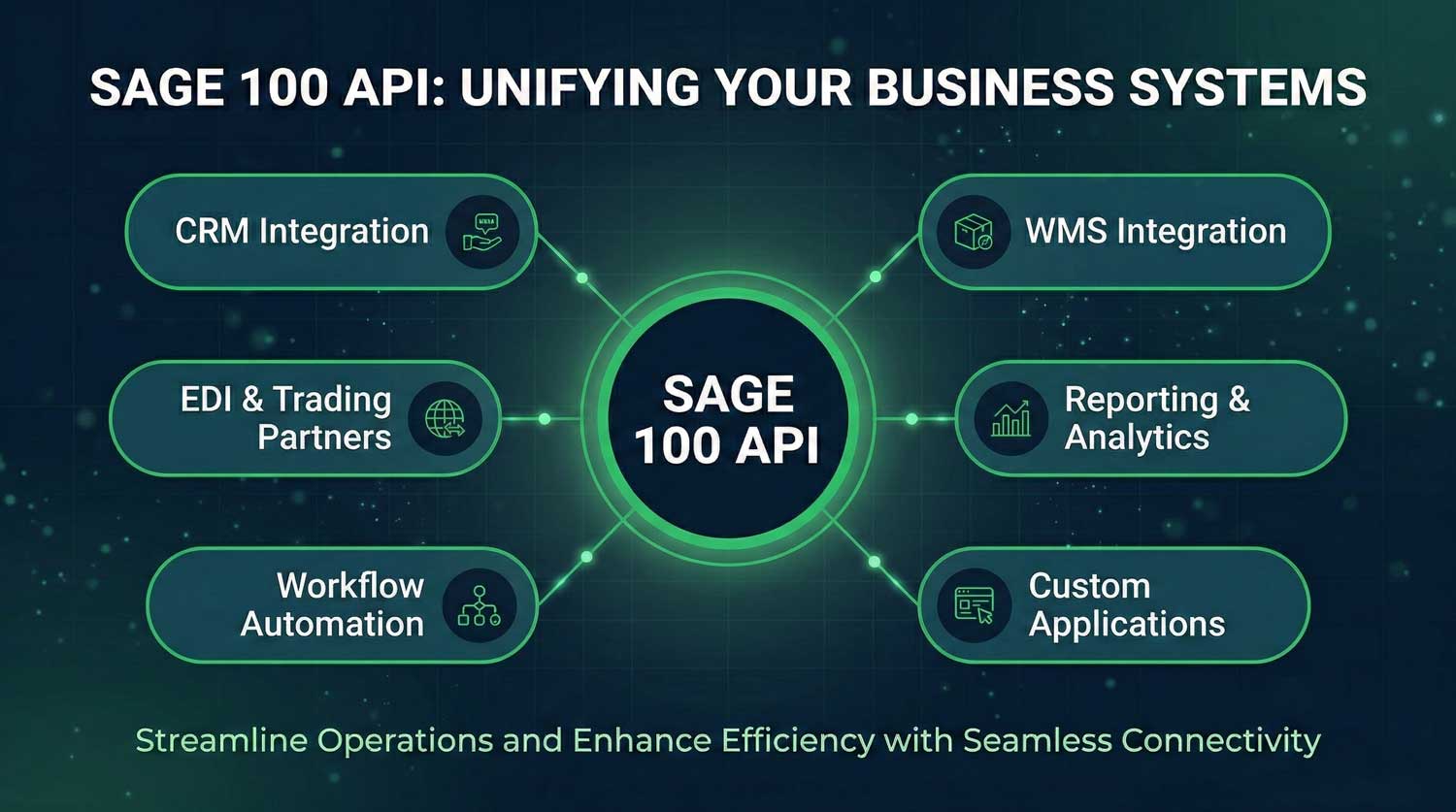
Your ERP should work seamlessly with the rest of your business systems. The Sage 100 API gives developers, consultants, and integration teams secure REST-based access to Sage 100 data. Automate workflows, integrate external systems, and extend ERP functionality without fragile scripts or direct database modifications.

Built on a proven integration platform, the Sage 100 API is designed for real-world business and technical use cases, from CRM and WMS integration to custom reporting and workflow automation.

Connect Sage 100 to the Systems That Power Your Business

Your business relies on multiple applications — CRM, WMS, EDI platforms, reporting tools, and custom software. The Sage 100 API provides a reliable way to connect these systems directly to Sage 100, enabling automated, accurate data exchange without manual intervention.

It supports real-time or scheduled data updates, one-way or bi-directional sync, and hub-and-spoke or hybrid architectures, making integrations flexible and maintainable.

Extend Sage 100 Without Custom Code

Customizing core ERP logic increases upgrade risk and maintenance overhead. The Sage 100 API allows developers to extend functionality around Sage 100 by exposing data and triggering workflows without modifying the ERP itself.

This approach helps organizations:
-Reduce technical debt
-Simplify upgrades
-Support long-term integration strategies
-Automate operational workflows

Common Sage 100 API Use Cases

The Sage 100 API supports a wide range of integration and automation scenarios:

CRM Integration

Connect customer, contact, and order data between Sage 100 and your CRM system for accurate and up-to-date records.

Warehouse Management Systems

Synchronize inventory, fulfillment, and shipping information to ensure real-time accuracy across systems.

EDI & Trading Partners

Automate communication with retailers, distributors, and suppliers using your existing EDI or partner platforms.

Custom Reporting & Analytics

Expose Sage 100 data to BI tools, dashboards, and analytics platforms without impacting ERP performance.

Workflow Automation

Eliminate manual entry for sales orders, invoices, inventory adjustments, and notifications.

Integration for Custom Applications

Build custom apps around Sage 100 for specialized business processes without touching core ERP logic.

From Manual Workarounds to Automated Integrations

A Sage 100 API replaces disconnected processes with structured, reliable data flows.

Before Sage 100 API
After Sage 100 API
“Every system has its own version of customer data, and keeping them in sync is nearly impossible.”
  • Centralized customer data across systems
  • Automated updates between Sage 100 and external platforms
“We rely on CSV imports and exports that constantly break when something changes.”
  • Real-time or scheduled API-based data exchange
  • Fewer errors and less manual intervention
“Our reporting tools can’t easily access Sage 100 data without impacting performance.”
  • Secure API access for BI and reporting tools
  • Accurate insights without slowing the ERP
“Custom integrations are hard to maintain and even harder to upgrade.”
  • API-driven integrations that remain stable across upgrades
  • Cleaner, maintainable architecture
“We can’t easily connect Sage 100 to new systems as the business grows.”
  • Flexible integration framework for new applications
  • Faster time to value for new initiatives
“Manual workflows slow us down and create errors in daily operations.”
  • Automated workflows for customer/vendor updates, sales orders, and inventory
  • Reduced errors and faster processing
Thank you for taking the time to contact us. We have received your information and our team will get back to you as soon as possible.
Oops, an error occurred! Reload the page and try again.

Ready to Build Better Sage 100 Integrations?

The Sage 100 API gives your team the tools to automate workflows, connect systems, and extend ERP functionality — without sacrificing stability or control.

Request API access to see how the Web-Stor–powered Sage 100 API can support your integration strategy.

“We went from an extensive manual process to now having a fully touchless process.”

— Insha Naqvi, IT Manager at Pajunk Medical Systems

Why Use the Web-Stor API for Sage 100?

Designed for both business outcomes and technical credibility, the Sage 100 API delivers value across teams.

REST-Based API Access

Modern RESTful architecture provides reliable, scalable access for developers and teams.

Broad Sage 100 Object Coverage

Supports virtually all Sage 100 business objects, enabling deep integrations across financials, operations, inventory, and reporting.

Compatible with All Supported Sage 100 Versions

Ensures your integrations remain stable as Sage 100 evolves.

Secure & Controlled Data Exchange

Provides authenticated, structured access to ERP data without direct database connections, keeping your information safe and controlled.

Built on a Proven Integration Engine

Powered by the flexible, time-tested Web-Stor Integration Platform used for enterprise-grade Sage 100 integrations, delivering stability and reliability.

Designed for Developers, Trusted by Businesses

Offers developer-friendly access with a focus on automation, accuracy, and long-term maintainability, while delivering measurable business outcomes.

Hear From Our Clients

Many Sage 100 companies come to us with complex integration and automation challenges.

Across industries, our customers rely on Kissinger Associates to simplify processes, improve accuracy, and strengthen the systems their businesses run on.

Here’s how organizations we serve have experienced smoother operations, better visibility, and exceptional support through our integration solutions and Sage 100 expertise.

Inter-American Defense Board

“That’s the thing with Kissinger: you get experts, highly-knowledgeable people who are also very attentive to our needs, and they know how to solve critical problems the first time. It’s a really, really great experience.” 

Oscar Gomez
Deputy Director For Resource Management 
Georgia Underground Superstore

“The Kissinger consultants are such an integral part of our IT team. Their level of professionalism and in-depth expertise is unmatched. Whenever we need something adjusted, Kissinger gets it done for us in 30 minutes or less. They understand how important this is for us and it’s so refreshing to we have an IT partner we can trust.”

Josh Higley,
Projects & IT Director
Silver Springs Bottled Water Co.

“The support is wonderful. [Our Kissinger technician] is the best. He is extremely patient. Other technicians we have worked with there are also very good. They go above and beyond in helping me. My boss and I both agree that we stand behind the superb service that Kissinger gives. The technicians have always gone out of their way to make me feel that any problems that we have they can resolve. That is peace of mind!!! I really appreciate the technicians...they do an outstanding job!”

Shelene Weinberg
EDI Manager
MMTC, Inc.

“I used to have to input everything manually. It’s a huge time-saver and our customers are more satisfied. Everyone at Kissinger is easy to work with. They understood our needs and created an integrated solution that gives us exactly what we wanted”.

Jennifer Callanan
Office Manager
S & L Industrial 

“We love Kissinger. We have always been 100% satisfied with them. The service we have received in the past two years is unsurpassed by others.”

Kimberly Angell
Project Manager / Safety Manager
PolyFlo, Inc.

"Our conversion and implementation were very smooth, and caused little disruption in our day to day operations. We were able to retain the desired information that we needed from our [Sage 50] system. We would strongly recommend Kissinger to anyone in need of an accounting system and support."

Mike Reber
Controller

Who Uses the Sage 100 API?

The Sage 100 REST API is used by:

-In-house development teams extending ERP functionality
-ISVs building Sage 100–connected applications
-Integration and eCommerce agencies supporting client environments
-Sage 100 consultants delivering custom integrations

This flexibility makes the API suitable for both technical teams and business-led integration initiatives.

Request Sage 100 API access today.

“When we connected Kissinger with our developers, they were all speaking the same language! Within a week the sytems were pushing data back and forth flawlessly!”

— Geoffrey Robinson at Koobani

Thank you for taking the time to contact us. We have received your information and our team will get back to you as soon as possible.
Oops, an error occurred! Reload the page and try again.

Related Resources

Discover how our solutions can streamline your business operations, enhance eCommerce capabilities, and optimize your ERP and EDI processes. Our team provides the expertise and tools needed to drive efficiency and long-term growth.

Sage 100 API Blog

Learn how the Sage 100 API can help you connect systems, automate tasks, and extend your ERP capabilities. Practical insights for getting more from Sage 100.

  • Tips for building effective integrations
  • How APIs streamline workflows
  • Real-world Sage 100 examples
Read the Sage 100 API Blog
Sage 100 eCommerce Integration

Connect Sage 100 to your eCommerce platform to manage inventory, pricing, and orders from a single system. Grow your online sales without operational headaches.

  • Real-time inventory and order syncing
  • Flexible platform integration (Shopify, BigCommerce, WooCommerce)
  • Improve online customer experience
Learn About Sage 100 eCommerce
Sage 100 EDI Integration

Automate EDI transactions to reduce manual work, cut errors, and maintain trading partner compliance. Keep your supply chain running smoothly with Sage 100.

  • Hands-free EDI order processing
  • Full compliance with your trading partners’ EDI requirements
  • Scalable solution for growing businesses
Discover Sage 100 EDI Automation

Proven Success Across Industries

Discover how businesses across various industries have overcome challenges, optimized operations, and achieved long-term success with our ERP and Integration solutions:

Operational Efficiency Saves $50,000 Annually

Learn how Fayman Group USA partnered with Kissinger for customized KPI reporting that saves the company $50k+ every year.

Read the Full Story
99% Faster Order Processing & $40k+ Annual Savings

Learn how TruBeauty Concepts has achieved automated eCommerce order workflow and nuanced pricing integration, creating significant on-going savings.

Read the Full Story
40+ Hours a Week of Manual Processing Eliminated

Learn how Pajunk partnered with Kissinger Associates to achieve fully automated EDI processing between GHX and Sage 100.

Read the Full Story
Q&A

Frequently Asked Questions about the Sage 100 API

Can you write data to Sage 100 using an API?

Yes. This Sage 100 API supports both read and write operations, allowing external systems to safely create and update records inside Sage 100. Common use cases include creating sales orders, updating customers, adjusting inventory, posting invoices, and synchronizing financial data.

What makes this approach reliable is that all write operations are processed through Sage 100’s native business logic. This ensures validations, calculations, and posting rules are enforced exactly as they would be for a user working inside the ERP. Transactions are handled in a controlled way, reducing the risk of incomplete records, out-of-balance entries, or corrupted data that can occur with database-level writes.

Does Sage 100 have a real REST API?

Sage does not provide a native, out-of-the-box REST API for Sage 100. Many integrations marketed as “Sage 100 APIs” rely on direct database access, ODBC connections, or file imports rather than true application-level interfaces.

This Sage 100 API provides REST-based access by wrapping Sage 100 business objects and processes, not just exposing database tables. External systems interact with Sage 100 using standard HTTP methods while the API layer handles validation, transaction control, and version differences. This approach delivers the benefits developers expect from a REST API while preserving the integrity of the ERP.

What data and objects can be accessed through a Sage 100 API?

The API provides access to a broad set of Sage 100 business objects commonly required for integrations. These include customers, vendors, items, inventory, pricing, sales orders, invoices, purchase orders, general ledger data, and other operational and financial records.

In addition to standard objects, the API can access Sage 100 user-defined tables, enabling integrations to support custom fields and extensions without modifying core ERP logic. Objects are exposed through consistent REST endpoints, making it easier for developers to build, maintain, and scale integrations across multiple systems.

Is it safe to integrate with Sage 100 using an API?

Yes. This API is designed specifically to integrate with Sage 100 safely by enforcing native business rules and validations. Unlike direct database access, which bypasses Sage 100’s application logic, API requests are processed using the same rules that apply to users working inside the system.

This approach helps prevent common integration problems such as incomplete transactions, invalid statuses, posting failures, and data inconsistencies. It also reduces long-term risk by ensuring integrations remain stable and compatible as Sage 100 is upgraded or extended.

How is this Sage 100 API different from ODBC or direct database access?

ODBC and direct database access interact with Sage 100 at the table level, bypassing application logic, validations, and transactional controls. While this can work for basic reporting, it introduces significant risk when used for operational integrations or write operations.

This Sage 100 API interacts with the ERP through business objects and application processes. That means calculations, dependencies, and posting behavior are handled correctly. The result is more reliable integrations, fewer data issues, and reduced maintenance effort over time — especially for complex or high-volume integrations.

Does this Sage 100 API work with all supported versions?

Yes. The API is compatible with all supported versions of Sage 100. Differences between versions are handled within the API layer, so developers do not need to write or maintain version-specific logic in their applications.

This simplifies long-term integration maintenance and reduces the risk that an ERP upgrade will break connected systems. Integrations built on the API remain consistent even as Sage 100 evolves.

Is the Sage 100 API real-time or batch-based?

The API supports real-time, synchronous communication with Sage 100. External systems can request current data or submit transactions and receive immediate responses, making it suitable for time-sensitive integrations.

This real-time capability is commonly used for eCommerce order processing, EDI transactions, CRM synchronization, automation workflows, and custom applications that require up-to-date information and immediate validation feedback.

How does authentication and security work for this Sage 100 API?

The API uses secure authentication and encrypted communication to control access to Sage 100 data. Permissions can be scoped to specific objects and actions, helping organizations maintain strong data security and governance.

Can developers build custom applications on top of Sage 100?

Yes. The API is designed for professional developers building custom applications, integrations, or middleware solutions. It provides predictable endpoints, structured responses, and consistent behavior across environments.

How are errors handled when integrating with Sage 100?

When an API request fails, the system returns structured error responses with meaningful status codes and detailed messages. These responses identify validation issues, missing or invalid data, and processing errors within Sage 100.

This allows developers to log errors, surface meaningful feedback to users, and implement retry or exception-handling logic within their integration workflows. Clear error handling is essential for maintaining reliable, automated integrations and reducing troubleshooting time.

Can this Sage 100 API support complex integrations like eCommerce or EDI?

Yes. The API is designed to support complex, multi-system integrations that involve high transaction volumes and multiple data flows. This includes eCommerce platforms, EDI providers, CRMs, WMS systems, and custom middleware solutions.

Its architecture supports reliable transaction handling, structured error responses, and integration patterns that scale. This makes it suitable not just for simple data access, but for production-grade integrations where accuracy, performance, and visibility are critical.

Who provides and supports this Sage 100 API?

This Sage 100 API is developed and supported by Kissinger Associates, a Sage 100 Master Developer with decades of real-world experience implementing, extending, and integrating Sage 100. The API is maintained alongside active customer use cases, ensuring it evolves based on real integration requirements rather than theoretical designs.

Ongoing support and expertise help ensure long-term stability, faster issue resolution, and confidence for organizations building mission-critical integrations on top of Sage 100.