


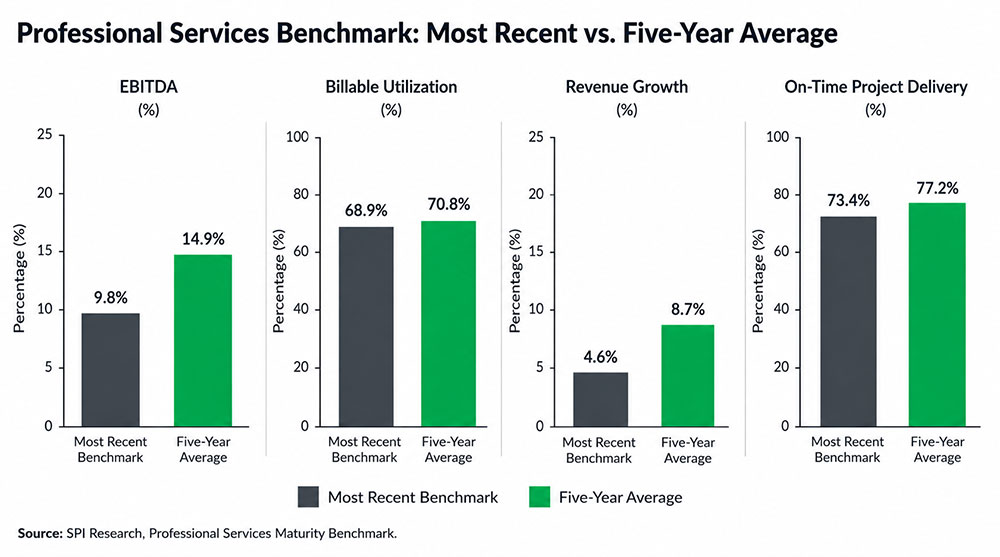
According to SPI Research's most recent Professional Services Maturity Benchmark — which surveyed 403 professional services firms across seven industries — average EBITDA dropped to 9.8%, the steepest single-year decline in the study's 18-year history. Billable utilization fell to 68.9%, below the 75% threshold that generally separates healthy operations from those under margin pressure. Revenue growth slowed to 4.6%, well below the five-year average of 8.7%.
The firms absorbing that decline aren't being outcompeted on talent or service quality. They're leaking revenue through operational gaps that are fixable — if you know where to look.
Here are four places to start:
1. Find out where your non-billable hours are actually going
Every professional services firm has non-billable time. Business development, internal meetings, proposal work, training — none of it goes away, nor should it. The question isn't whether non-billable hours exist. It's whether you actually know how much time they're consuming and where specifically they're concentrated.
Most firms don't. They track billable hours rigorously and treat non-billable time as a rounding error. The result is that administrative bloat, redundant processes, and inefficient workflows quietly accumulate while leadership focuses on revenue.
The fix is straightforward in principle: ask your team to log non-billable time with the same discipline they apply to billable work. What surfaces is almost always instructive. The activities consuming the most time are rarely the ones leadership assumes — and they're usually fixable with process changes that cost very little to implement.
One note on how you gather this feedback: some of what you'll hear is uncomfortable. Make it possible for people to share anonymously. You'll get a more accurate picture, and your team will trust that you're genuinely trying to fix the problem rather than assign blame.
2. Treat project scope as a financial control, not just a delivery concern
Scope creep is the most expensive thing that happens in a professional services firm that nobody documents.
A client asks for a small change. An account manager agrees to absorb it rather than create friction. The project team does the work. No one bills for it. Multiply that across a portfolio of active engagements and the revenue impact is significant — and invisible, because it never shows up as a loss. It just never shows up as revenue.
Three disciplines together close most of this gap. First, every client request that falls outside the original project scope gets documented and invoiced, regardless of size. Second, project spending is tracked in real time — not at month-end when it's too late to course-correct. Third, standardized processes are in place so that the time required to execute common project tasks is predictable and consistently estimated.
None of this requires sophisticated technology to start. It requires agreement that scope is a financial boundary, not a negotiating position.
3. Utilization is a data problem before it's a scheduling problem
The most recent SPI Research benchmark puts average billable utilization at 68.9% — below the 75% threshold that generally separates healthy professional services operations from those under margin pressure.
The firms consistently maintaining utilization above that threshold share one operational characteristic: they have real-time visibility into where their people are deployed, what skills they're applying, and where capacity exists before it becomes either a bottleneck or a gap. They make staffing decisions based on data, not institutional knowledge and educated guessing.
Improving utilization doesn't start with working people harder. It starts with knowing, at any given moment, what your current utilization actually is — by person, by practice area, by project type — and using that information to make better deployment decisions before the work starts rather than after it's already off-track.
For most firms, that means moving financial and resource data out of disconnected spreadsheets and into a system that surfaces it in real time. The utilization improvement follows from the visibility. It rarely works the other way around.
4. Your pricing probably hasn't kept up with your costs
This is the conversation most professional services firm leaders are reluctant to have — with their clients, and sometimes with themselves.
If your cash flow regularly tightens in the second half of a project, or if engagements that look profitable at the proposal stage consistently underperform at close, the most likely explanation is that your rates haven't kept pace with your actual cost of delivery. Inflation, rising labor costs, increased overhead, and scope assumptions that don't reflect current reality all accumulate over time. Pricing reviews don't.
The data here is clarifying. McKinsey research found that a 1% increase in price, holding volume constant, produces an 11% improvement in operating profit for the average company. For a professional services firm with tight margins, that ratio is often even more favorable.
The practical starting point is a project-by-project profitability review using historical data — comparing what each engagement actually cost to deliver against what it generated in revenue. The pattern that emerges will tell you where your pricing assumptions are most out of alignment with reality, and give you a defensible basis for rate adjustments with clients.
Raising prices feels risky. Continuing to underprice your work has a guaranteed cost.
The underlying issue all four strategies share
Non-billable time, scope management, utilization, and pricing are four distinct operational levers. But they have a common dependency: you can only act on what you can see.
Firms that consistently outperform on profitability don't have better instincts than the ones that don't. They have better data — specifically, the ability to see in real time what their projects cost, where their people are deployed, and where revenue is being left on the table. That visibility is what turns these four strategies from good ideas into measurable results.
The gap between a Level 1 firm and a Level 5 firm in the SPI maturity model isn't talent or market position. It's operational infrastructure — the systems and processes that make financial performance visible and actionable before it becomes a problem.
If your current systems make that visibility difficult, the strategies above will help, but only to a point.
Frequently asked questions
What is a good profit margin for a professional services firm?
The five-year average EBITDA for professional services firms is approximately 14.9%, according to SPI Research's annual benchmark. The most recent data showed a decline to 9.8%, reflecting industry-wide margin pressure. High-performing firms at the top maturity levels consistently achieve EBITDA above 20%. Commodity PS firms offering routine services typically see margins in the single digits, while specialized firms addressing complex client problems can exceed 30%.
How do you calculate billable utilization?
Billable utilization is calculated by dividing total billable hours by total available working hours, expressed as a percentage. If a consultant has 160 available hours in a month and logs 120 billable hours, their utilization rate is 75%. Industry benchmarks suggest 75% is the threshold separating healthy PS operations from those under margin pressure. The most recent SPI Research benchmark puts the industry average at 68.9%.
What causes low profitability in consulting firms?
The most common causes are excessive non-billable time that goes untracked, scope creep that is absorbed rather than billed, low billable utilization due to poor resource visibility, and pricing that hasn't kept pace with actual delivery costs. Firms relying on disconnected financial and project management systems are disproportionately affected because they lack the real-time visibility needed to identify and correct these issues before they compound.
How much does a 1% price increase affect profit margins?
According to McKinsey & Company research, a 1% increase in price, holding volume constant, produces an approximately 11% improvement in operating profit for the average company. For professional services firms with tight margins, this ratio is often even more favorable because the cost of delivery doesn't increase with a price adjustment.
What is the average EBITDA for a professional services firm?
The five-year average EBITDA for professional services firms is 14.9%, according to SPI Research's annual Professional Services Maturity Benchmark. The most recent benchmark period showed a decline to 9.8%, the steepest single-year drop in the study's 18-year history. High-performing Level 5 firms show profit margins 537% higher than Level 1 firms.
See what modern financial management looks like for PS firms
Kissinger Associates implements and supports Sage Intacct for professional services firms across North Americac. Firms using Sage Intacct for project-based financial management report an average 441% ROI over three years, according to a Forrester Total Economic Impact study — with payback in under six months.
If the gaps described above feel familiar, it's worth a conversation.
Schedule a conversation with Kissinger Associates →
Or explore what Sage Intacct looks like in practice for a professional services firm:





.svg)
.png)