

What is Inventory Cycle Count?
An inventory cycle count is a systematic auditing process that counts small portions of inventory on a rotating schedule rather than counting all inventory at once. Organizations count inventory using systematic procedures to ensure accuracy and efficiency. This statistical sampling approach verifies that physical inventory matches system records without disrupting normal warehouse operations or business processes.
Unlike traditional inventory counting methods, cycle counting divides total inventory into manageable sections that are counted throughout the year. Each section receives attention on a predetermined schedule, ensuring complete coverage over a reasonable period while maintaining operational continuity. Counting items in each section is a fundamental part of the process, transforming inventory management from a periodic disruption into an ongoing, integrated business process.
The cycle counting process operates on the principle that frequent, targeted counts of specific inventory items provide better accuracy than infrequent counts of entire inventory. This process counts inventory regularly to identify and resolve inventory discrepancies, helping businesses maintain accurate records. By focusing counting resources on high-value items, fast-moving stock, and problematic locations, businesses achieve superior inventory accuracy with significantly less effort and cost.
Cycle counts integrate seamlessly with both periodic and perpetual inventory systems. In periodic systems, cycle counts supplement less frequent physical inventories. In perpetual systems, cycle counts verify the continuous tracking provided by inventory management software and real-time transaction recording by comparing the system count to the physical count.
Statistical sampling principles underpin effective cycle counting. Rather than counting every item to achieve 100% verification, cycle counting uses representative samples to validate inventory accuracy across the entire stock. This approach is cycle counting based on item importance, frequency, or location, providing reliable data for decision-making while optimizing counting frequency and resource allocation.
Modern inventory management often leverages technology, such as a mobile device, to streamline and improve the efficiency of cycle counting.
The benefits of cycle counting include improved inventory accuracy, reduced operational disruptions, and better decision-making. Implementing cycle counting best practices and inventory cycle counting best approaches helps maintain on hand inventory accuracy and supports efficient warehouse operations.
To maximize these benefits, organizations should perform cycle counting as part of their regular inventory management operations, ensuring ongoing accuracy and control.
Inventory Cycle Count vs Physical Inventory Count
Understanding the fundamental differences between cycle counting and physical inventory counting helps determine the optimal approach for your inventory management strategy. The following comparison highlights key operational and financial distinctions:
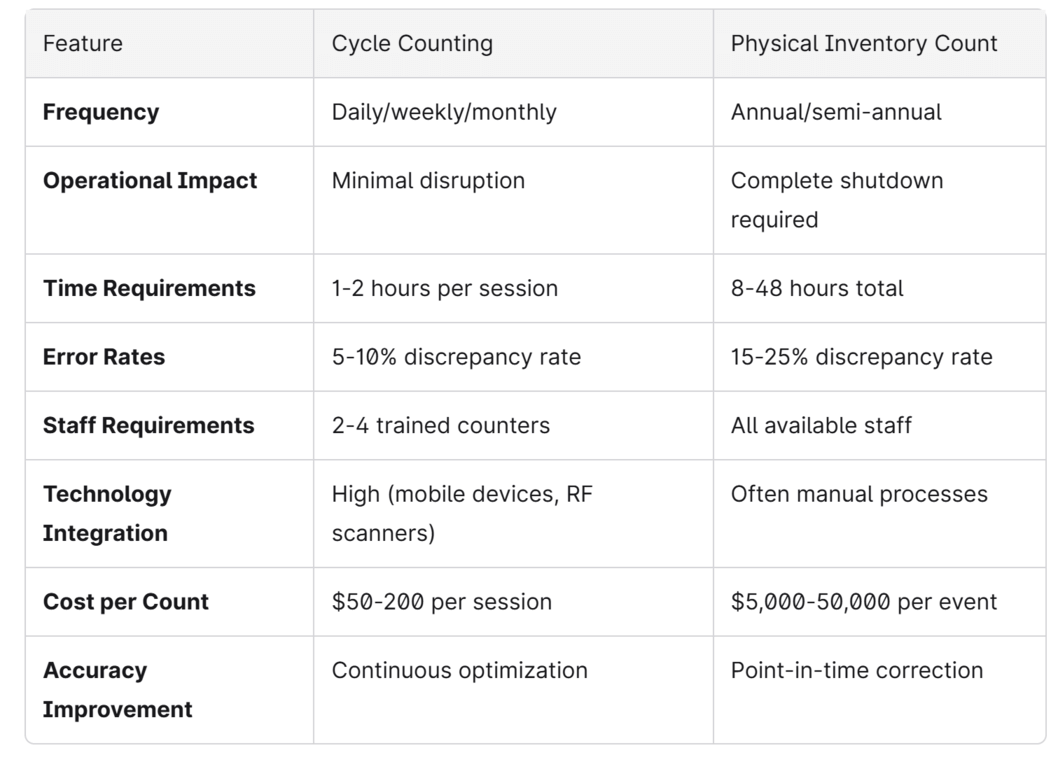
Physical inventory counts involve counting 100% of inventory once or twice yearly, typically requiring business closure and extensive overtime labor. This approach creates significant operational disruption while concentrating counting efforts into short, intense periods that often produce counting errors due to fatigue and time pressure.
Cycle counts break inventory into manageable sections counted throughout the year, allowing normal operations to continue while maintaining ongoing accuracy verification. This distributed approach reduces stress on counting teams and provides continuous feedback for process improvement.
The time savings achieved through cycle counting extend beyond the counting process itself. Physical inventory counts require extensive preparation, coordination, and post-count reconciliation that can consume weeks of management attention. Cycle counting integrates into daily operations without requiring special preparation or coordination efforts.
Many companies combine both approaches for optimal results, using cycle counting for ongoing accuracy maintenance and annual physical counts for comprehensive verification and regulatory compliance. This hybrid approach captures the benefits of continuous monitoring while satisfying audit requirements and providing complete inventory validation.
Benefits of Inventory Cycle Counting
Implementing a systematic cycle counting program delivers measurable improvements across multiple operational areas. Companies typically achieve return on investment within 12 months of implementation, with benefits extending far beyond simple inventory accuracy.
Improved Inventory Accuracy represents the primary benefit, with organizations reporting accuracy improvements of up to 40% compared to annual physical counting alone. Class A items consistently achieve 90-95% accuracy rates, while even Class C items maintain 85-90% accuracy through systematic cycle counting. This enhanced accuracy directly translates to better purchasing decisions and reduced safety stock requirements.
Reduced Safety Stock Requirements result from improved confidence in inventory data. When actual inventory levels match system records consistently, businesses can operate with 15-20% lower safety stock while maintaining the same service levels. This reduction frees up significant working capital for other operational investments.
Lower Overhead Costs accumulate through multiple efficiency gains. The elimination of annual shutdown costs, reduced overtime labor, and decreased expediting fees combine to reduce total inventory management costs by 25-30%. These improvements in inventory management and reduced discrepancies lead to significant cost savings. Additional savings emerge from reduced obsolete inventory and improved space utilization.
Continuous Inventory Monitoring enables proactive management rather than reactive corrections. Real-time discrepancy detection allows immediate investigation and correction, preventing small issues from becoming major problems. This ongoing oversight maintains inventory accuracy between formal audits.
Prevention of Stockouts and Overstock Situations improves through accurate demand planning based on reliable inventory data. Companies using cycle counting report 25% fewer stockouts and 20% reduction in excess inventory compared to those relying solely on periodic physical counts.
Better Purchasing Decisions result from confidence in inventory data accuracy. Procurement teams can optimize order quantities, timing, and supplier relationships based on accurate consumption patterns and actual stock levels rather than estimates and assumptions.
Improved Customer Satisfaction follows naturally from better inventory accuracy. Order fulfillment rates improve by 15-20% when inventory records accurately reflect available stock, reducing backorders and shipping delays that damage customer relationships.
The cumulative effect of these benefits creates a competitive advantage that extends throughout the supply chain. Organizations with superior inventory accuracy operate more efficiently, respond faster to market changes, and deliver better customer service than competitors using less sophisticated inventory management approaches.
Types of Inventory Cycle Counting Methods
Selecting the appropriate cycle counting method depends on inventory characteristics, warehouse operations, and business objectives, and often involves choosing a cycle counting based approach tailored to your specific business needs. Each method offers distinct advantages and addresses specific operational challenges. Understanding these approaches enables optimization of counting resources and accuracy outcomes by applying cycle counting best practices.
ABC Cycle Counting Method
ABC cycle counting applies the Pareto Principle to inventory management, categorizing items based on their value contribution to total inventory investment. This method concentrates counting resources on inventory items that have the greatest financial impact while maintaining oversight of lower-value items through less frequent counts.
Classification Criteria typically follow the 80/20 rule, though specific percentages may vary based on business characteristics:
- A Items: Represent 10-20% of total SKUs but account for 70-80% of inventory value. These high-value items receive weekly or bi-weekly cycle counts to maintain maximum accuracy.
- B Items: Comprise 20-30% of SKUs and represent 15-25% of inventory value. These medium-value items are counted monthly or quarterly depending on turnover rates.
- C Items: Include 50-70% of SKUs but represent only 5-10% of total inventory value. These items receive quarterly or semi-annual counts.
Items are classified using multiple criteria including sales volume, cost per unit, profit margin, and strategic importance. High-volume consumables might be classified as A items regardless of unit cost due to their operational criticality.
The ABC counting method focuses audit resources where discrepancies have the greatest financial impact. A 5% error in Class A inventory typically represents more dollar value than a 20% error in Class C inventory, making frequent A item counts financially justified.
Implementation Example: A distribution center with 10,000 SKUs might designate 2,000 items as Class A (counted weekly), 3,000 items as Class B (counted monthly), and 5,000 items as Class C (counted quarterly). This schedule ensures complete inventory coverage every three months while concentrating effort on high-impact items.
Random Sample Cycle Counting
Random sample cycle counting selects items for counting through statistical sampling methods, ensuring broad inventory coverage over time without the classification requirements of ABC analysis. This approach works particularly well for businesses with diverse inventory mixes where value-based classification is difficult or inappropriate.
Constant Population Approach maintains the same pool of potential items for each counting session. Every SKU has an equal probability of selection for each count, though some items may be counted multiple times while others remain uncounted for extended periods.
Diminished Population Approach—also known as diminished population counting—removes counted items from the selection pool temporarily, ensuring broader coverage before any item is counted twice. This method guarantees complete inventory coverage within a predetermined timeframe.
Daily or weekly counting schedules provide continuous inventory verification. A warehouse counting 50 items daily from a 10,000 SKU inventory achieves complete coverage every 200 working days, or approximately once per year.
Random cycle counting excels in environments where all inventory items have similar characteristics or where ABC classification is impractical. This method also serves as an excellent starting point for organizations new to cycle counting, providing experience and baseline accuracy data before implementing more sophisticated approaches.
Control Group Cycle Counting
Control group cycle counting repeatedly counts a small set of items to detect and correct systematic counting errors. This method functions as a quality control mechanism for the overall cycle counting program rather than a standalone inventory verification approach.
A typical control group includes 10-50 items with known accurate quantities that are counted frequently—often daily or weekly. The same trained team performs these counts using standard procedures to identify inconsistencies in counting techniques, training gaps, or procedural problems.
Error Detection Process involves analyzing control group results for patterns that indicate systematic problems. Consistent discrepancies suggest training issues, while random errors might indicate procedural weaknesses or environmental factors affecting counting accuracy.
Continuing counts until all errors are resolved ensures that counting procedures produce reliable results before applying them to the broader inventory. This validation process prevents systematic errors from spreading throughout the cycle counting program.
Control group cycle counting proves especially valuable during initial implementation or when introducing new counting personnel. The method provides immediate feedback on counting quality and identifies training needs before they impact overall inventory accuracy.
Geographic/Location-Based Counting
Geographic cycle counting divides inventory by physical warehouse locations, organizing counting activities around storage areas, aisles, or zones. This method emphasizes the importance of counting inventory at each specific physical location, optimizing workflow efficiency and ensuring comprehensive coverage of all storage locations.
Spatial Organization groups items by their physical proximity rather than value or usage characteristics. Counters work systematically through designated areas, reducing travel time and ensuring no locations are overlooked.
Benefits for large warehouses include improved counting efficiency and better identification of location-specific problems. Storage areas with recurring discrepancies can be targeted for more frequent attention or process improvements.
Simultaneous Location Counting requires counting all items in locations where the same SKU appears to maintain accuracy. If an item appears in three different storage locations, all three locations must be counted during the same cycle to prevent double-counting or omissions.
This approach proves particularly effective for identifying problematic storage areas where environmental factors, handling practices, or security issues create recurring discrepancies. Geographic patterns in inventory variance often reveal operational problems that wouldn’t be apparent through other counting methods.
Usage-Based Cycle Counting
Usage-based cycle counting prioritizes items based on transaction frequency or movement velocity rather than value or location. This method targets inventory items that experience the most activity and therefore have the highest probability of discrepancies.
High-Usage Items such as daily consumables, fast-moving spare parts, or frequently picked products receive more frequent counts than slow-moving inventory. The logic recognizes that items with more transactions have more opportunities for errors to occur.
Counting frequency adjustments reflect actual item movement patterns. Items with daily transactions might be counted weekly, while items with monthly movement might be counted quarterly. This approach aligns counting resources with discrepancy probability.
Transaction-Driven Scheduling uses inventory management system data to identify items with high activity levels automatically. Items exceeding predetermined transaction thresholds trigger inclusion in upcoming cycle counts without manual intervention.
Examples include counting PPE and safety equipment daily due to high consumption rates, while counting seasonal items only during active periods. This method ensures that operationally critical items maintain high accuracy while optimizing resource allocation.
Inventory Cycle Count Process: Step-by-Step Implementation
Successful cycle counting requires systematic execution of standardized procedures. The following step-by-step process ensures consistent results and provides framework for continuous improvement. Each phase builds upon previous steps to create comprehensive inventory verification system.
Pre-Count Preparation
Review and Correct Existing Records forms the foundation of accurate cycle counting. Before beginning any physical count, verify that all recent inventory transactions have been properly recorded in the inventory management system. Outstanding receipts, shipments, transfers, and adjustments must be processed to ensure system accuracy.
Create Comprehensive Cycle Count Schedule specifying exact items, locations, and timing for each counting session. The schedule should identify specific SKUs, storage locations, expected quantities, and assigned counting teams. This detailed planning prevents confusion and ensures complete coverage.
Prepare Counting Materials including mobile devices, barcode scanners, counting sheets, and backup documentation systems. Technology failures can disrupt counting activities, making backup procedures essential for maintaining schedule adherence.
Assign and Train Counting Teams for designated areas based on experience and expertise. Teams should understand specific procedures for their assigned locations and receive training on any special handling requirements or safety protocols.
Verification of inventory transaction cutoff ensures that all activity occurring before the count begins is properly recorded. This cutoff prevents double-counting or omission of items that move during the counting process.
Executing the Count
Generate Cycle Count Report from the inventory management system containing current system quantities for all items to be counted. This report serves as the baseline for comparison and should include item descriptions, locations, and unit of measure information.
Systematic Physical Counting follows predetermined procedures to ensure accuracy and completeness. Counters should work methodically through assigned areas, using barcode scanning where possible and manual verification when necessary.
Barcode Scanning and Mobile Technology implementation accelerates counting while reducing transcription errors. Modern mobile devices integrate with inventory management software to provide real-time updates and immediate discrepancy flagging.
Record Discrepancies immediately when physical counts differ from system records. Documentation should include actual quantities found, system quantities expected, and any obvious explanations for variances such as damaged goods or mislocated items.
Count teams should maintain segregation of duties, with one person counting and another recording to prevent errors and fraud. This dual verification process improves accuracy while providing audit trail documentation.
Post-Count Actions
Reconcile Discrepancies through systematic investigation of root causes. Small variances might be accepted based on predetermined tolerance levels, while significant discrepancies require detailed investigation before adjustment.
Adjust Inventory Records based on verified physical counts following established approval procedures. Large adjustments should require management approval and documentation of investigation results.
Update Reorder Points and Place Orders as needed based on actual inventory levels discovered during counting. Accurate inventory data enables optimal purchasing decisions and prevents stockouts.
Calculate Inventory Accuracy Rates using the Inventory Record Accuracy (IRA) formula: (Number of matched items ÷ Total items counted) × 100. This metric tracks cycle counting effectiveness and identifies areas for improvement.
Schedule Next Cycle Count based on established frequency parameters and any specific issues identified during the current count. Items with recurring discrepancies may require more frequent attention.
Documentation of lessons learned and process improvements ensures continuous enhancement of cycle counting procedures. Regular review of counting results identifies patterns that indicate systematic issues requiring corrective action.
Inventory Cycle Count Best Practices
Implementing proven best practices transforms cycle counting from a basic verification activity into a strategic inventory management tool. These guidelines represent accumulated wisdom from successful implementations across diverse industries and operational environments.
Establish Consistent Timing for cycle counting activities to minimize operational disruption and maximize accuracy. End-of-shift or early morning counts typically provide the most stable inventory conditions with minimal transaction activity interfering with counting procedures.
Implement Comprehensive Staff Training covering not only counting procedures but also understanding of inventory variance causes and proper documentation requirements. Well-trained teams produce more accurate results and identify process improvement opportunities.
Maintain Rigorous Accuracy Tracking using standardized metrics and regular performance reviews. Teams should understand accuracy expectations and receive feedback on their performance to drive continuous improvement.
Use Technology Consistently including mobile devices, barcode scanners, and real-time inventory updates. Technology reduces counting time by 60% while improving accuracy by 40% compared to manual processes.
Segregate Counting Duties to prevent fraud and errors through dual verification processes. One person counts while another records, and different individuals should perform periodic verification counts on high-value items.
Freeze Inventory Movement in counting areas during active counts to prevent confusion and ensure accurate results. This temporary restriction prevents items from being moved, received, or shipped during counting activities.
Investigate All Significant Variances immediately rather than simply adjusting quantities. Understanding root causes prevents recurring problems and identifies systematic issues requiring process improvements.
Document Procedures Thoroughly including specific steps, approval requirements, and exception handling protocols. Written procedures ensure consistency across different teams and shifts while supporting audit requirements.
Conduct Regular Mock Counts using known quantities to test team accuracy and identify training needs. These practice sessions improve skills without affecting actual inventory records.
Maintain Clean, Organized Storage Areas to facilitate accurate counting and reduce errors caused by poor visibility or difficult access. Good housekeeping practices directly impact counting efficiency and accuracy.

Cycle Count Frequency and Scheduling
Optimizing cycle count frequency balances accuracy requirements with resource constraints while ensuring complete inventory coverage within reasonable periods. Effective scheduling considers item characteristics, operational requirements, and available resources to create sustainable programs.
Quarterly Full Coverage represents the minimum frequency for complete inventory verification through cycle counting. This standard ensures that every item receives attention at least four times per year while spreading counting effort evenly across operational periods.
Daily Cycle Counts for high-priority sections maintain tight control over critical inventory items. High-value items, fast-moving consumables, and operationally critical supplies benefit from daily cycle counts, which help improve accuracy, reduce discrepancies, and streamline inventory reconciliation—especially when integrated with automation and mobile scanning technology.
Frequency Adjustments based on item characteristics optimize resource allocation by concentrating effort where discrepancies have the greatest impact. Value, usage rate, and criticality all influence appropriate counting frequency for specific items.
Specific Examples of frequency optimization include:
- Daily counts for personal protective equipment and safety supplies
- Weekly counts for high-value items exceeding $1,000 unit cost
- Monthly counts for medium-value items and moderate-usage spare parts
- Quarterly counts for low-value, slow-moving inventory
Integration with Procurement Cycles ensures that cycle counts occur before reorder decisions to prevent purchasing based on inaccurate inventory data. Coordinating counting schedules with procurement planning maximizes the value of accurate inventory information.
Seasonal adjustments modify counting frequency based on business cycles and demand patterns. Items with seasonal usage patterns may require more frequent counting during active periods and less attention during dormant seasons.
Resource Planning considers available staff time, technology resources, and operational constraints when establishing counting schedules. Sustainable programs balance accuracy objectives with realistic resource limitations to ensure long-term success.

Technology and Automation in Cycle Counting
Modern technology transforms cycle counting from labor-intensive manual processes into efficient, accurate operations that integrate seamlessly with broader inventory management systems. Understanding available technologies and their implementation requirements enables optimization of counting procedures.
Inventory Management Software Integration provides the foundation for effective cycle counting by automating schedule generation, variance reporting, and record adjustments. Modern inventory control software and warehouse management systems (WMS) include integrated cycle counting modules that eliminate manual coordination and reduce administrative overhead. Inventory control software streamlines and automates inventory management processes, replacing manual systems like Excel spreadsheets, enhancing cycle counting accuracy, and integrating with ERP platforms to improve data management and reduce human error.
Mobile RF Scanners and Barcode Technology accelerate physical counting while reducing transcription errors. Workers equipped with mobile devices can scan items, verify locations, and input quantities directly into the inventory management system, eliminating paper-based processes and immediate data availability.
Real-Time Data Updates enable immediate inventory record adjustments and exception reporting. When physical counts differ from system records, automatic variance reports trigger investigation procedures and management alerts, accelerating problem resolution.
Offline Capabilities ensure counting productivity in areas with poor wireless connectivity. Modern mobile devices store counting data locally and synchronize with central systems when connectivity is restored, preventing communication issues from disrupting operations.
Productivity Improvements from technology implementation typically include:
- 60% reduction in labor time required for counting activities
- 40% improvement in counting accuracy compared to manual processes
- 80% reduction in data entry errors through automated scanning
- 50% faster variance resolution through real-time reporting
Return on Investment Considerations justify technology investments through labor savings, accuracy improvements, and reduced inventory carrying costs. Most organizations achieve payback within 18-24 months of implementation, with ongoing benefits continuing indefinitely.
RFID Technology Integration enables passive inventory tracking for high-value items, though implementation costs currently limit widespread adoption. RFID tags provide continuous location and quantity updates without manual scanning requirements.
Artificial Intelligence Applications increasingly support cycle counting through predictive analytics that identify high-risk items requiring attention. AI algorithms analyze transaction patterns, variance history, and operational factors to optimize counting schedules automatically.
Cloud-based inventory management platforms enable multi-location cycle counting coordination and centralized reporting. Organizations with multiple facilities can standardize procedures, share best practices, and aggregate performance metrics across all locations.
Common Cycle Counting Challenges and Solutions
Successful cycle counting implementation requires addressing predictable challenges that emerge in most operational environments. Understanding these obstacles and proven solutions accelerates implementation and prevents common pitfalls.
Multiple Location Complexity occurs when single SKUs appear in various storage areas throughout the facility. Coordinating simultaneous counts across all locations prevents double-counting while ensuring complete coverage.
Solution: Implement location-based counting schedules that group all locations containing specific items into single counting sessions. Use mobile technology to guide counters to all relevant locations and verify complete coverage.
Paperwork Delays and Manual Processes slow cycle counting and introduce transcription errors that reduce accuracy. Manual data recording creates bottlenecks and opportunities for mistakes that undermine counting effectiveness. These issues can introduce inventory errors, especially when paperwork delays or outdated transactions cause false variances. Real-time updates are essential to minimize these errors and improve inventory management.
Solution: Deploy mobile technology with real-time data transmission to eliminate paper-based processes. Barcode scanning and voice-directed systems reduce manual data entry while accelerating counting procedures.
Real-Time Update Failures prevent immediate inventory record adjustments, reducing the value of cycle counting data. Delayed updates allow continued operations based on inaccurate inventory information.
Solution: Implement robust wireless infrastructure and backup communication methods. Train staff on offline procedures and ensure rapid system recovery to minimize disruption periods.
Opened Box Distribution creates counting complexity when partial quantities appear in multiple locations. Standard counting procedures may not accommodate split quantities effectively.
Solution: Develop specific procedures for partial quantity handling, including consolidation requirements and documentation standards. Use unit-of-measure conversions and decimal counting when appropriate.
“Good Enough” Approach Limitations emerge when organizations accept approximate counts for low-value items. This practice can accumulate significant errors over time despite individual item insignificance.
Solution: Establish clear tolerance levels based on item value and criticality. Maintain exact counts for items above tolerance thresholds while accepting reasonable approximations for truly insignificant items.
Human Error Reduction requires ongoing training and quality control measures to maintain counting accuracy. Even experienced teams can develop bad habits or become complacent over time.
Solution: Implement regular accuracy testing using control groups and known quantities. Provide refresher training quarterly and recognize teams achieving high accuracy rates.
Mock Cycle Count Implementation helps identify procedural gaps and training needs before they impact actual inventory records. Practice sessions using test data reveal process weaknesses safely.
Solution: Conduct monthly mock counts using predetermined quantities and evaluate team performance. Use results to identify training needs and refine procedures before actual implementation.
Measuring Cycle Count Success
Effective measurement systems track cycle counting performance using standardized metrics that enable continuous improvement and demonstrate program value. Key performance indicators provide objective assessment of accuracy, efficiency, and operational impact.
Inventory Record Accuracy (IRA) Formula provides the fundamental measurement of cycle counting effectiveness: (Number of items with matched quantities ÷ Total number of items counted) × 100. This percentage indicates how frequently physical counts match system records.
Target Accuracy Rates should approach 100% for optimal performance, though practical targets often range from 95-98% depending on operational characteristics. Class A items should consistently achieve higher accuracy rates than Class C items due to increased counting frequency.
Nine Crucial KPIs for comprehensive cycle counting assessment include:
- Overall Inventory Accuracy Rate - Percentage of items counted that match system records
- Accuracy by Item Classification - Separate rates for A, B, and C class items
- Counting Productivity - Items counted per hour by team and individual
- Variance Investigation Time - Average time required to resolve discrepancies
- Adjustment Frequency - Percentage of counts requiring inventory record changes
- Coverage Completeness - Percentage of planned items actually counted on schedule
- Cost per Count - Total program costs divided by items counted
- Schedule Adherence - Percentage of planned counts completed on time
- Error Recurrence Rate - Frequency of repeated discrepancies for specific items
Industry Benchmark Comparisons provide context for performance evaluation. Leading organizations typically achieve 95-98% accuracy rates with productivity of 50-100 items counted per hour, depending on warehouse layout and technology deployment.
Continuous Improvement Process uses measurement results to identify enhancement opportunities. Monthly performance reviews should examine trends, investigate recurring problems, and implement corrective actions to optimize program effectiveness.
Financial Impact Measurement quantifies cycle counting benefits through inventory carrying cost reductions, stockout prevention, and operational efficiency gains. These metrics demonstrate return on investment and justify continued program support.
Exception Reporting identifies items with recurring discrepancies for special attention. Items appearing on variance reports repeatedly may require process improvements, security enhancements, or reclassification to higher counting frequencies.
Industry-Specific Cycle Counting Applications
Different industries face unique challenges that require tailored approaches to cycle counting implementation. Understanding industry-specific considerations ensures that cycle counting programs address relevant operational requirements and regulatory compliance needs.
Retail Operations emphasize theft prevention and shrinkage control through frequent cycle counting of high-value merchandise and loss-prone items. Fashion retailers might count seasonal items weekly during peak sales periods while maintaining quarterly counts for basic merchandise.
Implementation Focus: Point-of-sale integration enables real-time inventory updates, while security considerations require tamper-evident storage and dual verification procedures for expensive items. Geographic counting by store sections helps identify location-specific shrinkage patterns.
Manufacturing Environments prioritize raw materials and work-in-process inventory to support just-in-time production requirements. Critical components receive daily attention to prevent production interruptions, while finished goods follow ABC classification principles.
Case Study Example: An automotive manufacturer implemented daily cycle counting for Class A components (representing 80% of production value) and achieved 98% inventory accuracy. This accuracy improvement reduced emergency expediting costs by $2.3 million annually while preventing three production line shutdowns.
Healthcare Facilities focus on controlled substances, expensive medical devices, and items with expiration dates. Daily cycle counting of narcotics and weekly counts of high-value surgical supplies ensure regulatory compliance while supporting patient care requirements.
Regulatory Considerations: DEA regulations require specific documentation and audit trails for controlled substances. Medical device tracking regulations mandate lot number and expiration date verification during cycle counting procedures.
Dental Practices emphasize consumable supplies and high-value equipment to maintain treatment capabilities without excessive inventory investment. Daily counts of frequently used consumables prevent patient appointment delays due to stockouts.
Special Requirements: Temperature-sensitive materials require specialized storage verification, while infection control protocols may limit counting frequency to prevent contamination risks.
Industry-specific software solutions often include pre-configured cycle counting procedures that address regulatory requirements and operational characteristics. These specialized systems accelerate implementation while ensuring compliance with industry standards.
Success metrics vary by industry, with healthcare focusing on regulatory compliance and stockout prevention, while retail emphasizes shrinkage control and turnover optimization. Manufacturing operations prioritize production support and carrying cost reduction.
Understanding Inventory Management
Inventory management is the backbone of any successful business operation, ensuring that the right products are available at the right time to meet customer demand while minimizing costs. Effective inventory management encompasses a variety of activities, including tracking inventory levels, monitoring stock movements, and optimizing storage and handling processes. One of the most impactful tools within this framework is cycle counting—a systematic approach to regularly verifying the quantity of inventory on hand.
By integrating a robust cycle counting process into your inventory management strategy, you can significantly enhance inventory accuracy and reduce the risk of costly errors. Regularly tracking inventory and conducting targeted counts allows businesses to quickly identify discrepancies, address issues before they escalate, and maintain optimal inventory levels. This proactive approach not only supports better decision-making but also streamlines the entire counting process, ensuring that inventory data remains reliable and actionable.
Ultimately, strong inventory management supported by effective cycle counting leads to improved operational efficiency, reduced carrying costs, and a stronger ability to respond to market changes. Businesses that prioritize inventory accuracy through ongoing cycle counting are better positioned to meet customer expectations and maintain a competitive edge.
Counting and Reporting
The success of any cycle counting program hinges on the accuracy and reliability of its counting and reporting procedures. The counting process involves physically verifying the quantity of inventory items on hand and comparing these figures to the inventory records maintained in your inventory management system. This step is crucial for identifying inventory errors and ensuring that your records reflect the actual stock available.
There are several methods for conducting the counting process, ranging from traditional manual counts to more advanced techniques like barcode scanning and RFID technology. Each method offers varying levels of efficiency and accuracy, but the goal remains the same: to provide a clear and accurate snapshot of inventory at a given point in time.
Once the physical count is complete, the results must be carefully reported and reconciled with existing inventory records. Any discrepancies uncovered during the cycle counting process should be promptly investigated to determine their root cause—whether due to data entry mistakes, misplaced items, or other inventory errors. Accurate reporting not only maintains the integrity of your inventory management system but also supports ongoing process improvements and audit readiness.
By establishing rigorous counting and reporting protocols, businesses can minimize errors, enhance inventory accuracy, and ensure that their inventory management practices support overall operational goals.
Inventory Count and Control
Inventory count and control are essential practices for maintaining accurate and efficient inventory management. These processes encompass a range of activities, including cycle counting, periodic physical inventory counts, and perpetual inventory tracking, all aimed at ensuring that inventory records are consistently accurate and up-to-date.
Cycle counting plays a central role in inventory count and control by providing regular, targeted checks of inventory levels without the need for disruptive full physical inventory counts. When combined with other methods—such as annual or semi-annual physical inventory counts and real-time tracking through inventory management systems—businesses can achieve a comprehensive view of their inventory status.
Effective inventory count and control procedures help prevent inventory errors, reduce the risk of stockouts or overstocking, and optimize inventory levels to meet customer demand. By regularly reviewing and updating inventory records, businesses can quickly identify and correct discrepancies, streamline inventory tracking, and improve overall operational efficiency.
Incorporating robust inventory count and control measures into your inventory management strategy not only safeguards against costly mistakes but also supports better forecasting, purchasing, and customer service outcomes.
Transform Your Inventory Accuracy Starting Today
The evidence is overwhelming: companies using systematic inventory cycle counting achieve 40% better accuracy, 25% fewer stockouts, and complete ROI within 12 months. Yet most businesses continue suffering through annual physical counts that shut down operations, exhaust staff, and still produce 15-25% error rates.
The difference between inventory excellence and inventory chaos isn't technology or warehouse size—it's commitment to systematic cycle counting. While your competitors lose $50,000+ annually to inventory errors and emergency expediting, you could be operating with 95%+ accuracy and freed-up working capital.
Every day without proper cycle counting costs you. Not just in the obvious ways: stockouts, overstock, and counting overtime, but in the hidden costs of poor decisions based on bad data. When you can't trust your inventory numbers, everything downstream suffers: purchasing, production planning, customer service, and cash flow management.
The path from inventory uncertainty to inventory confidence starts with one simple step: conducting an ABC analysis of your current inventory. This foundational exercise identifies your high-impact items and creates the framework for systematic improvement that compounds over time.
Accurate inventory data from a disciplined cycle count program is also the foundation that makes AI-powered demand forecasting viable — if you're exploring that next step, our guide to AI demand forecasting for distributors covers what the data requirements actually look like.
Ready to Achieve 95%+ Inventory Accuracy?
At Kissinger Associates, we've helped hundreds of businesses implement cycle counting programs that transform inventory management from a weakness into a competitive advantage.
- ROI Calculator showing your specific savings potential
- Implementation Roadmap with week-by-week action plans
- Best Practices Guide from 300+ successful implementations
- 30-minute consultation with our inventory management experts
Schedule Your Free Consultation or call 800-562-5456 to speak with our inventory specialists today.
Stop counting everything once a year. Start counting what matters every day. Your path to inventory excellence begins now.
.webp)


.svg)
.png)